
Thin Insulation Solutions for Limited Loft Space
When your loft barely has room to store Christmas decorations, let alone accommodate thick traditional insulation, finding effective thermal protection...
Thin Insulation Solutions for Limited Loft Space
When your loft barely has room to store Christmas decorations, let alone accommodate thick traditional insulation, finding effective thermal protection becomes a real challenge. Many homes across the UK struggle with restricted roof space — whether due to low-pitched roofs, numerous joists, or conversion constraints. The good news is that innovative materials now offer impressive thermal performance without requiring significant depth, allowing you to meet building regulations and reduce energy bills even when space is at a premium.
Understanding Space Constraints in UK Lofts
Limited headroom affects millions of British homes, particularly older properties where roof structures weren’t designed with modern insulation requirements in mind. Traditional mineral wool or fibreglass batts typically need 270mm depth to achieve current building regulation standards, which simply isn’t feasible in many lofts.
Low-pitched roofs, common in 1960s and 1970s housing developments, often leave just 150mm between rafters and roof tiles. Victorian terraces frequently have complex timber frameworks that create awkward spaces difficult to fill with conventional materials. Even modern homes can present challenges when loft conversions or storage requirements compete for precious vertical space.
The Building Regulations Approved Document L requires new roof insulation to achieve U-values of 0.16 W/m²K or better. Achieving this performance with minimal thickness requires materials that offer superior thermal efficiency per millimetre — which is exactly where modern reflective systems excel.
Performance Benefits of Advanced Reflective Systems
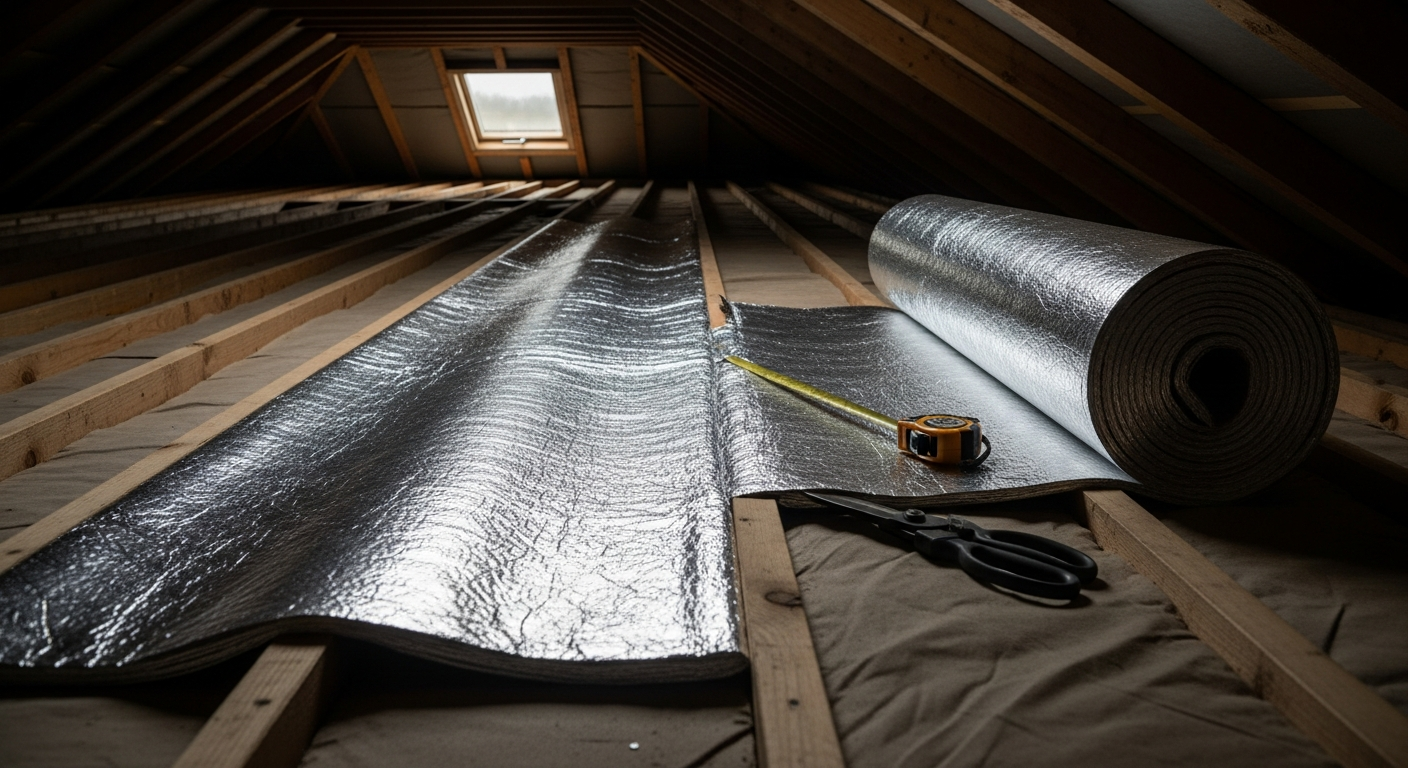
Multi-foil insulation represents a significant leap forward for space-constrained applications. These products combine multiple reflective layers with carefully engineered air gaps to create impressive thermal barriers in remarkably thin profiles.
A quality multi-foil system typically measures just 20-50mm thick yet can deliver thermal performance equivalent to 200mm+ of traditional materials. This efficiency comes from the way reflective layers work — rather than simply slowing heat transfer through conduction like conventional insulation, they reflect radiant heat back to its source.
The key lies in proper installation technique. Each reflective surface must face an air gap to function effectively, which is why we always ensure correct spacing when carrying out multi-foil installations. When installed properly, these systems create multiple thermal breaks that dramatically reduce heat loss through all three mechanisms: conduction, convection, and radiation.
Independent testing shows that premium multi-foil products can achieve thermal resistances of 3.75 m²K/W or higher — more than sufficient to meet current building standards whilst occupying minimal space.
Installation Considerations and Best Practices
Working with thin insulation materials requires precision and understanding of building physics principles. The most critical factor is maintaining proper air gaps — typically 20mm minimum — on both sides of reflective surfaces.
Continuous fixing battens are essential to prevent thermal bridging, where heat bypasses the insulation through structural elements. We use 25mm timber battens spaced at maximum 600mm centres, ensuring the reflective material doesn’t touch the roof deck or internal finish.
Overlaps between sheets need careful sealing with reflective tape to eliminate thermal bridges. Unlike traditional materials where small gaps might be acceptable, reflective systems demand complete continuity to maintain performance.
Ventilation becomes even more crucial with thin systems. The reduced air space means moisture management requires particular attention. We always ensure adequate ventilation paths remain clear, typically maintaining 50mm clearance at eaves and ridge.
Vapour control also needs consideration. Many multi-foil products incorporate vapour barriers, which must be positioned correctly and properly sealed to prevent condensation issues within the roof structure.
Comparing Options for Restricted Spaces
Several categories of thin insulation merit consideration for limited-height applications, each with distinct advantages.
Vacuum insulated panels represent the ultimate in space efficiency, achieving exceptional thermal performance in panels as thin as 20mm. However, their rigid format and higher cost make them more suitable for specific applications rather than general loft use.
Aerogel-enhanced products offer impressive performance per millimetre but come at premium prices. These materials work well for targeted applications like bridging thermal bridges or insulating complex junctions.
Multi-foil systems provide the best balance of performance, practicality, and cost-effectiveness for most residential applications. Our multi-foil insulation installation service focuses on these versatile materials because they deliver consistent results across varied roof configurations whilst remaining economically viable for typical homeowner budgets.
Hybrid approaches sometimes work well, combining thin high-performance materials with whatever traditional insulation space allows. This might involve using multi-foil at critical points where headroom is minimal, then supplementing with mineral wool in areas with more clearance.
Key Takeaways
• Multi-foil systems can achieve building regulation performance in 20-50mm thickness, making them ideal for space-constrained lofts • Proper installation with maintained air gaps and continuous vapour barriers is crucial for optimal performance • Reflective systems work by blocking radiant heat transfer, requiring different installation techniques than traditional materials • Professional installation ensures compliance with building regulations whilst avoiding costly moisture problems • Thin solutions cost more per square metre but often prove economical when considering the value of retained loft space
What Our Customers Say
Trusted by homeowners across Nationwide (Based in Southampton) — here's what they have to say.
"Brilliant service from start to finish. The team were professional, tidy, and explained everything clearly. Our energy bills have dropped noticeably since the new insulation went in."
"Had spray foam removed and mineral wool installed. The inspector was thorough and honest about what needed doing. Really impressed with the quality of work."
"We had terrible condensation in our loft. They diagnosed the problem quickly, improved the ventilation, and replaced the old insulation. No more damp and the house is noticeably warmer."
Frequently Asked Questions
Yes, when properly installed, multi-foil systems achieve equivalent thermal performance to much thicker conventional materials. Independent testing confirms that quality multi-foil products meet current building regulation U-values whilst using 80% less space than mineral wool alternatives.
Most multi-foil systems require approximately 65-70mm total depth when accounting for the material thickness plus essential air gaps on both sides. This makes them suitable for roofs with as little as 75mm clearance between rafters and roof covering.
Building regulations focus on thermal performance (U-values) rather than material thickness. Multi-foil systems that meet the required thermal standards and carry appropriate certification are fully acceptable for building control approval, provided installation follows manufacturer guidelines. Ready to maximise your loft's thermal performance despite space constraints? Contact us today to arrange a free survey where we'll assess your specific situation and recommend the most effective thin insulation approach for your property.
Ready for a Free Survey?
No obligation. We assess your property and provide a detailed quote — usually within 48 hours.