
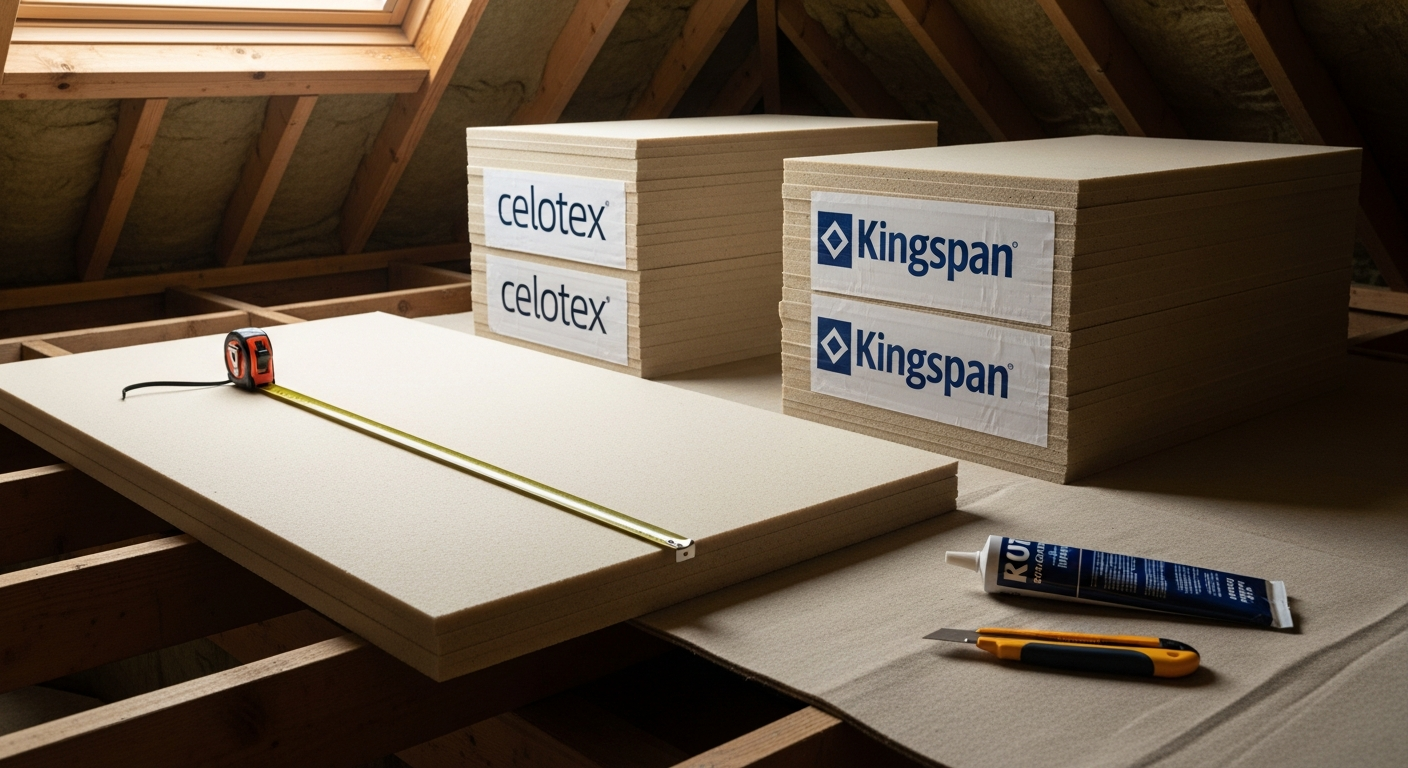
Celotex vs Kingspan: Which PIR Board Is Best?
When you're upgrading your home's insulation, choosing between the UK's two leading PIR board manufacturers can feel overwhelming. Both Celotex and...
Celotex vs Kingspan: Which PIR Board Is Best?
When you’re upgrading your home’s insulation, choosing between the UK’s two leading PIR board manufacturers can feel overwhelming. Both Celotex and Kingspan produce high-quality polyisocyanurate foam boards, but they each have distinct characteristics that might make one more suitable for your specific project. Understanding these differences will help you make an informed decision that delivers the thermal performance your home needs while staying within budget.
What Makes PIR Boards Different Between Brands
PIR insulation boards might look similar from the outside, but the manufacturing processes and core compositions vary between Celotex and Kingspan. Both use polyisocyanurate foam as their core material, but Celotex tends to produce a slightly denser foam structure, whilst Kingspan focuses on maximising thermal efficiency through their closed-cell technology.
The facing materials also differ significantly. Celotex typically uses aluminium foil facings across their range, which provides excellent vapour control and reflective properties. Kingspan offers more variety, including their distinctive silver foil facings, glass tissue options, and specialised facings for specific applications like pitched roofing or cavity walls.
These manufacturing differences translate into real-world performance variations. Celotex boards generally offer more consistent dimensional stability, making them easier to cut and fit precisely. Kingspan boards often achieve slightly better thermal conductivity values, though we’re talking about marginal differences that might not be noticeable in typical domestic applications.
Performance and Thermal Efficiency Comparison
When it comes to thermal performance, both manufacturers produce boards that comfortably exceed Building Regulations requirements. Celotex GA4000 typically achieves lambda values around 0.022 W/mK, whilst Kingspan Therma equivalent products often reach 0.020 W/mK or better.
In practical terms, this means you might achieve the same U-value with a slightly thinner Kingspan board compared to Celotex. However, the difference is usually only 5-10mm across typical thicknesses, and both will deliver excellent long-term thermal performance when installed correctly.
Fire performance is another crucial consideration. Both brands meet current UK fire safety standards, but Celotex has invested heavily in reformulating their products following the Grenfell inquiry. Their newer products demonstrate enhanced fire resistance characteristics, though both manufacturers’ current ranges are suitable for residential applications when used within their intended specifications.
We’ve installed thousands of square metres of both brands over the years, and the thermal performance differences in real homes are negligible. Your choice might come down to other factors like availability, cost, or specific application requirements.
Cost and Availability Factors
Pricing between Celotex and Kingspan fluctuates regularly based on raw material costs and market demand. Generally, you’ll find Celotex boards priced slightly lower than equivalent Kingspan products, though this isn’t always the case for specialist applications.
Availability can be the deciding factor on many projects. Celotex, being owned by building materials giant Saint-Gobain, often has better stock levels at national merchants. Kingspan’s distribution is excellent too, but during busy periods or for less common thicknesses, you might find longer lead times.
We always recommend checking current pricing and availability for your specific requirements rather than assuming one brand will always be cheaper. Market conditions change frequently, and bulk purchasing through trade accounts can shift the economics significantly.
Consider also that both manufacturers offer technical support and warranties. Kingspan tends to provide more comprehensive technical literature and online calculators, whilst Celotex offers straightforward product guides that many installers find more practical to use on-site.
Which Should You Choose for Your Project?
The honest answer is that both Celotex and Kingspan produce excellent PIR boards that will transform your home’s energy efficiency. Your choice should be based on your specific project requirements rather than brand loyalty.
Choose Celotex if you prioritise consistent quality at competitive pricing, need boards that are easy to cut and handle, or if your local merchant has better stock availability. Their standard range covers most domestic applications effectively.
Choose Kingspan if you need the absolute best thermal performance from thinner boards, require specialist facings for specific applications, or if you’re working on a project where their superior technical support resources add value.
For most homeowners undertaking loft conversions, cavity wall upgrades, or roof renovations, either brand will deliver excellent results when installed as part of a comprehensive PIR rigid insulation board fitting system. The installation quality and overall system design matter far more than the brand name on the board.
Key Takeaways
• Both Celotex and Kingspan produce high-quality PIR boards that exceed Building Regulations thermal performance requirements • Kingspan typically achieves marginally better thermal conductivity, whilst Celotex offers more consistent dimensional stability • Pricing fluctuates regularly, but Celotex is often slightly more affordable for standard applications • Availability varies by region and product specification, so check current stock levels before deciding • Installation quality matters more than brand choice for achieving optimal thermal performance in your home
What Our Customers Say
Trusted by homeowners across Nationwide (Based in Southampton) — here's what they have to say.
"Brilliant service from start to finish. The team were professional, tidy, and explained everything clearly. Our energy bills have dropped noticeably since the new insulation went in."
"Had spray foam removed and mineral wool installed. The inspector was thorough and honest about what needed doing. Really impressed with the quality of work."
"We had terrible condensation in our loft. They diagnosed the problem quickly, improved the ventilation, and replaced the old insulation. No more damp and the house is noticeably warmer."
Frequently Asked Questions
Yes, you can use different PIR board brands within the same installation, provided they meet the same performance specifications. We sometimes do this when stock availability requires it, ensuring consistent thermal bridging details and vapour control across all boards used.
Both brands install using identical methods and fixings. The cutting, handling, and sealing requirements are the same, though some installers find Celotex slightly easier to cut cleanly due to its denser foam structure.
Both manufacturers' current PIR boards maintain their thermal properties effectively over decades when installed correctly. Independent testing shows no significant difference in long-term performance degradation between quality products from either brand. Ready to upgrade your home's insulation with professional PIR board installation? Contact our experienced team for a detailed assessment of your property and personalised recommendations on the best PIR board solution for your specific requirements.
Ready for a Free Survey?
No obligation. We assess your property and provide a detailed quote — usually within 48 hours.